Connect with us
El-Dabaa Nuclear Power Plant Project Construction Phase Begins in Egypt

El-Dabaa Nuclear Power Plant Project Construction Phase Begins in Egypt

More Videos

Published

on

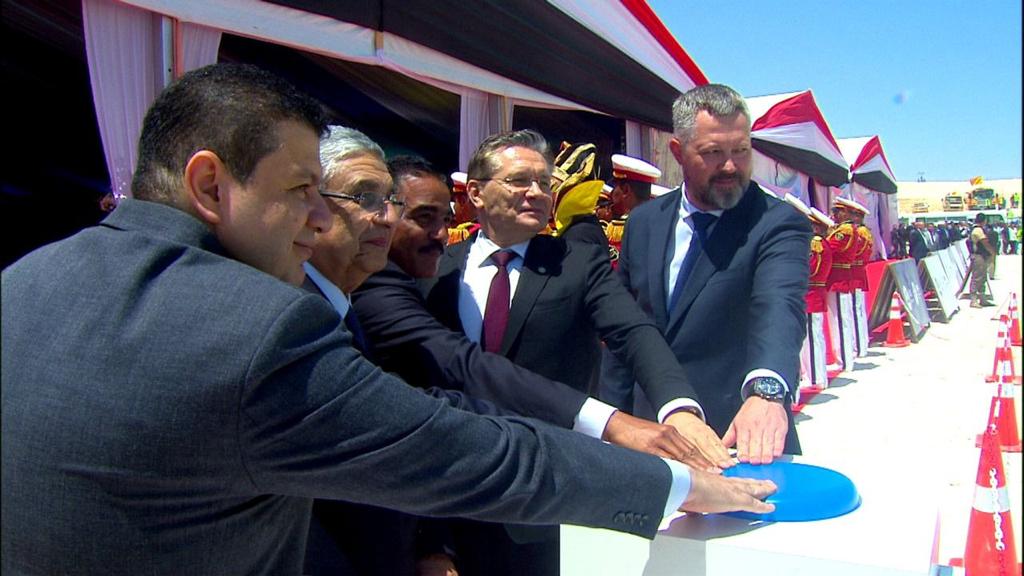
El-Dabaa Nuclear Power Plant Project Construction Phase Begins in Egypt—The “first concrete” pouring for the El-Dabaa Nuclear Power Plant Unit 1 has been performed by Alexey Likhachev, Rosatom Director General, and Mohamed Shaker, Egyptian Minister of Electricity and Renewable Energy at a ceremony held to commemorate the historic event.

Dr. Amged El-Wakeel, Board Chairman of the Nuclear Power Plants Authority of Egypt  (NPPA), the owner and future operator of the El-Dabaa Nuclear Power Plant, awarded honorary plaques commemorating the first concrete pouring to His Excellency Dr. Mohamed Shaker, Egyptian Minister of Electricity and Renewable Energy, Major-General Khaled Shoeib, the Governor of Matrouh, where the project is being built, Dr. Samy Shaaban Attallah, Chairman of the Egyptian Nuclear and Radiological Regulatory Authority (ENRRA), Alexey Likhachev, Rosatom Director General, Alexander Korchagin, Senior Vice President of ASE JSC and Grigory Sosnin, Vice President of ASE JSC and General Supervisor of the El-Dabaa NPP Project Management.

Mohamed Shaker and Alexey Likhachev also awarded members of the joint Russian-Egyptian project team in recognition of their outstanding efforts with commemorative medals.

Earlier, on 29 June 2022, ahead of schedule, the ENRRA issued the construction permit for the El-Dabaa Nuclear Power Plant Unit 1, allowing concrete pouring to commence.

“The construction launch at the El-Dabaa NPP Unit 1 means that Egypt has joined the nuclear club. Rosatom will build cutting-edge power units of VVER-1200 design in the Arab Republic of Egypt. We have gained experience constructing and operating NPPs with such reactors both in Russia and abroad. Construction of the nuclear power plant will allow Egypt to reach a new level of technology, industry and education development.

The plant will be the largest project of the Russian-Egyptian cooperation since the Aswan High Dam. Having its own nuclear energy industry has been a dream for the Egyptian people for more than half-a-century, and it is a great honor for Rosatom to make this dream come true,” Alexey Likhachev noted emphasizing the significance of the event.

Amged El-Wakeel, Board Chairman of the NPPA, welcomed the attendees and stated: “I would like to welcome all of you in today’s ceremony arranged to commemorate the pouring of the first concrete for the El-Dabaa Nuclear Power Plant Unit 1, which we are celebrating in the presence of His Excellency Dr. Mohamed Shaker, Minister of Electricity and Renewable Energy and Dr. Alexey Likhachev, Director General of Rosatom.

This day would not have been possible without the wise decision of His Excellency Abdel Fattah El-Sisi, President of the Arab Republic of Egypt, to initiate the Egyptian Nuclear Project, following which all state entities sparred no efforts to achieve this common goal through a deep understanding of the nature of Egypt’s Nuclear Programme, as part of the comprehensive renaissance contributing to the new republic.”

Mohamed Shaker also stated: “The ceremony commemorating the pouring of the first concrete for Unit 1 is a great delight for us. The commencement of full-scale construction of Unit 1 is a historic event for Egypt. The political leadership and the Egyptian-Russian cooperation contributed to the implementation of this ambitious project despite the challenges presented by the Covid-19 pandemic, which did not have a negative impact on the project.”


The El-Dabaa Nuclear Power Plant is the first nuclear power plant in Egypt. It will be constructed in the city of El-Dabaa, Matrouh Governorate, on the Mediterranean coast, roughly 300 km north-west of Cairo.

The El-Dabaa Nuclear Power Plant will consist of 4 units with a generating capacity equivalent to 1200 MW per unit using generation III+ VVER-1200 reactors (pressurized water reactors). This is the most advanced technology to date and it has already been successfully implemented and operated in Russia and abroad.


The Rosatom State Corporation Engineering Division unites the leading companies of the nuclear industry in Russia and abroad.

The Engineering Division ranks first in the world by the order portfolio and the number of NPPs constructed simultaneously across the world.

Facebook 0 Twitter/X 0 LinkedIn0 WhatsApp0 0Shares
Continue Reading
Click to comment

Leave a ReplyCancel reply

News

Global Wave of Cyber Intrusions Spares No Sector, but Nigeria’s Banking System Stands Resilient

Published

on

Global Wave of Cyber Intrusions Spares No Sector, but Nigeria’s Banking System Stands Resilient


By Adesegun Adeshi Gbenga


Nigerian banks have moved swiftly to contain the effects of a sophisticated global cyber campaign sweeping across sectors and continents, with industry sources assuring the public that the nation’s financial system remains strong, resilient and secure.


The campaign, described by analysts as one of the most coordinated waves of attacks in years, is neither peculiar to Nigeria nor limited to finance. Organisations in telecommunications, healthcare, government, energy, technology and corporate registries across Europe, Asia, the Americas and Africa have been targeted by the same wave of intrusions, underscoring the borderless nature of modern cybercrime.


The data is stark: CheckPoint, a leading international cybersecurity firm, reports a 115 per cent surge in attacks on the global financial sector last year, with organisations worldwide facing thousands of attempted intrusions weekly. The current campaign has been linked to threat actors that have struck more than 35 organisations across several countries and sectors.


Despite the onslaught, banking services and digital channels across Nigeria remain fully operational and customer deposits safe. Banks activated their incident response protocols as soon as reports emerged, working closely with regulators, law enforcement and international cybersecurity partners to investigate and strengthen their defences. Nigerian banks operate some of the most advanced cybersecurity infrastructure on the continent, backed by years of sustained investment in protecting customer information and assets. Experts note that resilience in an era of global cyber warfare lies not in immunity from attack, which no organisation can claim, but in the speed and rigour of response, and on that measure the industry has acted decisively and in full compliance with regulatory requirements.


The banking public is, however, urged to remain vigilant. Fraudsters often exploit moments of heightened attention with fake calls, text messages and emails. Customers should never divulge personal or banking information, including passwords, PINs, One-Time Passwords (OTPs), card details or Bank Verification Numbers (BVNs), to anyone over the telephone, however convincing the caller sounds; no bank will ever ask for these details.


They should also avoid opening suspicious emails, clicking unfamiliar links or downloading attachments from unknown senders. Anyone who suspects foul play or unusual account activity should contact their bank immediately, and only through its dedicated official channels: verified customer care lines, official websites, mobile applications or branches.


As governments and corporations worldwide race to shore up their digital defences, the message from the Nigerian banking industry is one of calm and confidence: the system is safe, deposits are secure, and the institutions entrusted with the nation’s savings remain watchful and prepared.


Facebook 0 Twitter/X 0 LinkedIn0 WhatsApp0 0Shares
Continue Reading

News

Zenith Bank: the best-in-class lender beyond balance-sheet size

Published

on

Zenith Bank: the best-in-class lender beyond balance-sheet size


Zenith Bank stands out as Nigeria’s best-in-class lender not simply because of the size of its balance sheet, but because of what it has consistently produced from that balance sheet: industry-leading profit, strong capital buffers, rising shareholder returns and an increasingly profitable international franchise.

That distinction matters amid recent industry discussions that have framed best-in-class banking largely around capitalisation, assets and scale.

Those measures matter, but they offer an incomplete picture of banking leadership. The stronger test is whether a bank can convert capital into sustainable earnings, diversify those earnings, manage risk, reward shareholders, and expand without weakening the franchise.

On that broader scorecard, Zenith has delivered.

Financial strength built over several years

Zenith’s performance is not the product of one strong quarter, nor is its leadership based on recording the fastest profit growth every year.

From 2021 to 2025, the bank’s profit after tax rose from N244.56 billion to N1.04 trillion, a compound annual growth rate of about 43.6%.

Over the five-year period, Zenith generated a combined N3.22 trillion in profit after tax; the highest cumulative profit among the listed banks.

The path was not a straight line, and that is part of the story. Profit dipped to N223.91 billion in 2022; a rare setback in an otherwise steady climb before rebounding sharply to N676.91 billion in 2023, crossing the trillion-naira mark in 2024 and holding above that level in 2025.

Although profit growth slowed to 0.74% in 2025, Zenith preserved its trillion-naira earnings base despite higher impairment charges and operating costs, while several major peers recorded outright profit declines.

The momentum continued into Q1 2026, when profit after tax reached N314.02 billion about 30% of the entire 2025 profit in just three months.

Earnings from more than customer loans

Zenith’s best-in-class position is also reflected in how effectively it puts its balance sheet to work.

In 2025, customer loans generated N1.82 trillion in interest income. But lending was no longer carrying the earnings burden alone. Treasury bills and government bonds contributed a combined N1.64 trillion, while placements with banks added another N210 billion.

This meant Zenith was earning across customer credit, government securities and interbank assets, giving the bank more than one source of interest income during a period of elevated rates and rising repayment risks.

The wider revenue mix also began to improve in Q1 2026. Fee and commission income rose 44.6%, while other operating income more than quadrupled.

That breadth strengthens Zenith’s leadership story. The bank is not simply accumulating assets; it is converting those assets, customer relationships and transaction platforms into recurring income. The next opportunity is to sustain the recovery in fee-based earnings, creating a more balanced revenue base as market conditions change.

Market performance

The market has also validated Zenith Bank’s leadership. The bank became the first listed Nigerian lender to cross the N5 trillion market-capitalisation mark in 2026, rising from N2.54 trillion at the end of 2025 to N5.36 trillion in April.

Zenith began the year at N61.80 per share. By July 24, the stock had risen to N126.50, lifting its market value to approximately N5.20 trillion. That represents a 104.7% gain in less than seven months and created about N2.66 trillion in additional market value.

The increase in Zenith’s valuation suggests that investors are rewarding not only its size, but also its ability to convert assets and capital into sustainable earnings and shareholder returns.

That confidence was tested in June, when a broader market correction wiped about N867 billion from Zenith’s market value. The response was equally telling: the stock recovered 15% in July, regaining approximately N678 billion within one month.

The rebound showed that investors viewed the correction as an opportunity rather than a reason to abandon the stock. It also reinforced a central part of Zenith’s best-in-class story: the market increasingly values the bank for the quality and consistency of its performance, not simply for the size of its balance sheet.

Total shareholders’ return

Zenith’s shareholder-value record extends beyond share-price appreciation.

Between 2020 and 2025, the bank paid about N1.02 trillion in cash dividends. Over the same period, dividend per share rose from N3 to N10, giving long-term investors a larger share of the bank’s earnings.

The biggest increase came in 2025, when Zenith more than doubled its total dividend payment to N410.70 billion and raised its payout ratio from 18.94% to 39.47%.

Even after that increase, the bank retained more than 60% of annual profit, preserving capital for regulatory requirements, technology investment and further expansion.

Zenith’s ability to increase distributions while retaining most of its earnings strengthens its long-term shareholder proposition.

On a simple, non-compounded basis, combining the 104.7% share-price gain with the 7.91% indicated dividend yield produces an estimated total shareholder return of about 112.6% so far in 2026.

The result is a balanced return story: shareholders benefited from cash income, a doubling of the share price, and a bank that continued to retain enough profit to finance its next stage of growth.

Capital strength behind the balance sheet

Zenith’s best-in-class position is not based merely on how large its balance sheet has become, but on the strength of the capital, liquidity, and risk discipline supporting it.

In 2025, total assets grew 5% to N31.46 trillion, while shareholders’ equity expanded more than four times faster, rising 22.2% to N4.92 trillion. Equity climbed further to about N5.17 trillion by Q1 2026.

That gap is significant. While asset growth increased Zenith’s scale, the much faster expansion in equity strengthened the financial foundation beneath that scale. It showed that the bank was not simply accumulating more assets and liabilities; it was building greater capacity to absorb losses and fund future growth.

Retained earnings rose 43.3%, further demonstrating how Zenith converted profitability into internal capital rather than relying excessively on external funding.

Risk discipline also improved alongside capital strength. The non-performing loan ratio improved from 4.7% to 3.8% following accelerated provisioning and the write-off of legacy exposures. The exercise pushed impairment charges to N741.6 billion, yet Zenith absorbed the cost while keeping profit above N1 trillion.

That combination; cleaner assets, stronger capital and sustained profitability is central to the distinction between size and leadership.

Zenith ended 2025 with a capital adequacy ratio of 25.3% and a group liquidity ratio of 71.1%, both comfortably above regulatory requirements. These buffers give the bank greater capacity to withstand losses, meet customer obligations, and continue supporting the economy during periods of financial stress.

A Pan-African franchise producing profit without straining capital

Zenith’s international network has become a genuine earnings platform. In 2025, its foreign banking subsidiaries generated about N223 billion in combined profit after tax more than one-fifth of group profit.

More importantly, this expansion has remained proportionate to the capital supporting it.  This means Zenith is not under pressure to dispose of profitable foreign subsidiaries to restore compliance or protect its ability to pay dividends.

Instead, the businesses can continue contributing earnings while the group preserves capital for risk absorption, domestic growth and shareholder returns.

The completed acquisition of Paramount Bank Kenya further demonstrates this disciplined approach to regional expansion. It strengthens Zenith’s East African presence and broadens its earnings base without materially weakening the group’s capital position or placing future distributions under strain.

Awards that confirmed the record

That record received international validation when Euromoney named Zenith both Africa’s Best Bank and Nigeria’s Best Bank in its 2026 Awards for Excellence; a dual win not based on balance-sheet size, but on profitability, asset quality, capital and liquidity, retail expansion, technology investment and disciplined African growth.

The continental award places Zenith alongside institutions from larger, more developed banking markets; the Nigerian award confirms its standing in one of the continent’s most competitive sectors.

Zenith does not lead every individual metric; other banks may have larger assets, wider footprints or stronger results on particular ratios.

But best-in-class banking is measured by the full outcome: more than N3.2 trillion in five-year profit, two consecutive years of trillion-naira earnings, over N1 trillion returned through dividends, shareholders’ equity beyond N5 trillion, and foreign businesses contributing more than one-fifth of group profit.

That is what separates scale from leadership, turning assets into earnings, earnings into capital, capital into resilience, and performance into measurable value for customers and shareholders.

Facebook 0 Twitter/X 0 LinkedIn0 WhatsApp0 0Shares
Continue Reading

Trending

Facebook 0 Twitter/X 0 LinkedIn0 WhatsApp0 0Shares