


ECOWAS Requires $5.2bn To Address Infrastructure Deficit, Says Commissioner


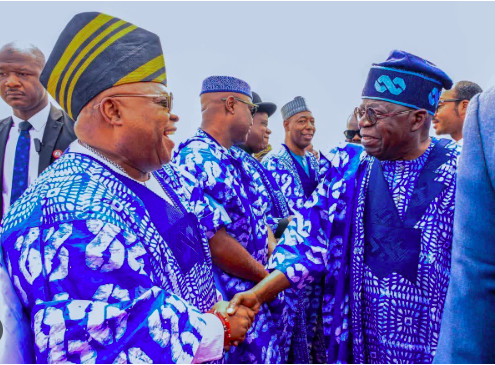
BREAKING: After Historic Osun Victory, Adeleke Backs Tinubu for 2027 Re-Election—-Fresh from securing a second term as Osun governor under the Accord Party, Ademola Adeleke has reaffirmed his support for President Bola Tinubu’s bid for another term in 2027.
Osun State Governor Ademola Adeleke has reaffirmed his support for President Bola Ahmed Tinubu’s bid for re-election in 2027, shortly after securing another four-year term as governor of the state.
Adeleke made the declaration in his victory speech following his successful re-election in the August 15 governorship election, where he contested under the Accord Party after leaving the Peoples Democratic Party (PDP).
The governor’s renewed endorsement of Tinubu adds another significant dimension to his remarkable political journey. Adeleke won his first term as governor in 2022 on the PDP platform but subsequently moved to Accord ahead of the 2026 election, successfully defending his seat as an incumbent under his new party.
Adeleke Praises Tinubu After Election Victory
In his post-election remarks, Adeleke expressed appreciation to President Tinubu, who had called to congratulate him on his victory.

The Osun governor praised the President for what he described as his role in ensuring that democracy continued to thrive, while acknowledging Tinubu’s congratulatory gesture following the election.
Adeleke’s comments represent a notable development given the political rivalry and tensions that characterized the build-up to the Osun election.
Before the poll, the governor had repeatedly called on the Federal Government and security agencies to ensure a free, fair and peaceful election. His campaign also exchanged accusations with the APC over the conduct of the electoral process and the role of federal authorities.
Renewed Support for Tinubu’s 2027 Ambition
Adeleke’s endorsement of Tinubu for 2027 is not entirely new.
The governor had previously declared his support for Tinubu’s re-election campaign before the Osun governorship election. In June, while formally launching his Accord Party re-election campaign, Adeleke described his support for the President as “unshaken and total.”
He again reaffirmed that position after winning the Osun election, emphasizing his continued backing for the President’s second-term ambition. Vanguard and Punch both reported the governor’s renewed endorsement following his victory.
Adeleke also described Tinubu as a son of Osun, further highlighting the personal and political connection he says exists between the President and the state.
Adeleke’s Historic Political Switch
The endorsement comes just days after Adeleke achieved a major political feat by retaining the Osun governorship despite switching parties.
The governor was elected in 2022 as a PDP candidate but later abandoned the party following a prolonged internal crisis. He subsequently joined Accord and secured the party’s ticket to contest the 2026 election.
His decision created considerable political uncertainty because he was defending his position as an incumbent governor without the PDP structure that had originally brought him to power.
Adeleke ultimately overcame the challenge, winning another term under Accord and strengthening his position as one of the country’s most prominent politicians outside the traditional major-party platforms.
Tinubu Congratulates Adeleke
President Tinubu has also congratulated Adeleke on his re-election, describing the result as a reflection of the will of the people.
The President said the outcome demonstrated that democracy continues to flourish in Nigeria and urged the governor to use his renewed mandate to serve the people of Osun State.
The development creates an interesting political dynamic ahead of 2027, with Adeleke now firmly positioned as an Accord governor who is publicly supporting the incumbent President’s re-election bid.
For Adeleke, the immediate priority will be delivering on the mandate he has just received from Osun voters. But his decision to publicly back Tinubu also signals that his political calculations extend beyond the state and into the increasingly important national contest ahead of the 2027 presidential election.
After securing a historic second term under Accord, Adeleke has now turned his attention toward the next political battle — throwing his weight behind Tinubu’s bid to remain President beyond 2027.

-

 Trending News4 years ago
31 Pioneer Empowerment Project Trainees Graduate From Dominion Cares Foundation of RCCG Region 19
-

 News4 years ago
JUST IN: #Buhari Recalls Bashir Ahmad, Upgrades Him To Special Assistant
-

 News4 years ago
BREAKING: Femi #Otedola Endorses #Tinubu 2023 Presidential Bid [PHOTO]
-

 News4 years ago
#SuperTV Market Activation Train Storms Lagos Amidst Cheers from Lagosians
-

 Politics3 years ago
Upgrade Ikorodu General Hospital To Teaching Hospital, Oba Kabir Shotobi Urges Lagos Govt.
-

 Politics4 years ago
We’ve Interim Govt Proposal Ready, Chris Okotie Replies Yakasai, Critics
-

 News4 years ago
SuperTV Sets Abeokuta Agog With Exciting Consumer Activation [PHOTOS]
-

 Health & Wellbeing2 years ago
JUST IN: Federal Government Declares Free Cesarean Sections For All Nigerian Pregnant Women

