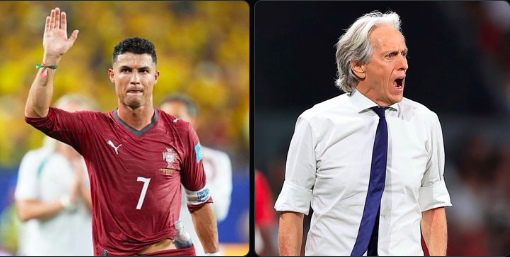
BREAKING: Cristiano Ronaldo Breaks Silence on Portugal Exit, Accuses Jorge Jesus of Breaking His Word—-The 41-year-old Portugal captain apologised for leaving the national-team camp but said he remains available for selection after serving any punishment imposed by the Portuguese Football Federation.
Cristiano Ronaldo has broken his silence over his controversial departure from the Portugal national team camp, accusing head coach Jorge Jesus of breaking his word twice and revealing the circumstances that led him to walk away from the squad.
In a lengthy statement released on Tuesday, October 6, Ronaldo gave his own account of the dispute, while also apologising to his teammates and Portuguese supporters for leaving the camp ahead of Portugal’s Nations League fixture against Denmark.
Despite the fallout, Ronaldo made it clear that he has not walked away from international football and remains willing to represent Portugal again.
“If I’m physically fit, playing for my club and scoring goals, after serving whatever suspension is imposed on me, I’ll be available, as I have always been until now, to compete and win for our national team,” Ronaldo said in his statement.
Ronaldo Reveals What Happened
According to Ronaldo, his initial discussions with Jorge Jesus were centred on managing his workload because of his fitness.
The Portugal captain said Jesus had originally agreed that he would miss the matches against Norway and Denmark as part of a plan to manage his physical condition.
However, Ronaldo claimed that shortly before the Norway match, Jesus told him he would play for approximately 30 minutes.
Ronaldo said he subsequently warmed up from halftime but was never introduced.
“Everyone knows the rest. I warmed up from halftime onwards, watched the minutes tick by and wasn’t called on,” Ronaldo said, describing the incident as the first occasion when Jesus had broken his word to him.
The forward said the situation became even more difficult after a subsequent meeting involving Jesus and Al Nassr sporting director Simao Coutinho.
Ronaldo said they agreed that Jesus would publicly clarify the circumstances surrounding his decision not to use him against Norway.
An eight-point document was reportedly prepared, with Ronaldo saying it made clear that he had never demanded playing time, had respected the coach’s decisions and that asking him to warm up without eventually introducing him had been a mistake.
However, Ronaldo claimed that Jesus’ subsequent public comments did not reflect the agreement they had reached privately.
He therefore accused the coach of breaking his word for a second time.
“It was the second time he had broken his word to me,” Ronaldo said. “I decided to leave the training camp without waiting for any further broken promises.”
Ronaldo Apologises to Portugal
Ronaldo also accepted responsibility for his decision to leave the squad.
The veteran forward apologised to his teammates for abandoning the training camp and admitted that his position as Portugal captain made the incident more serious.
“I owe an apology to my national team teammates for having left the camp,” Ronaldo said.
He also apologised to Portuguese supporters for failing to greet them following the Norway match.
However, Ronaldo insisted that he believed leaving was ultimately the right decision after he felt his continued presence could negatively affect the team.
He said he was prepared to accept whatever disciplinary action the Portuguese Football Federation decides to impose.
“The consequences of my actions must be assessed and punished by the Portuguese Football Federation,” he stated.
Ronaldo Rules Out a Permanent Exit
Despite the controversy, Ronaldo insisted that his future with Portugal remains open.
The five-time Ballon d’Or winner rejected the suggestion that he was simply seeking a farewell appearance before permanently ending his international career.
He said Portugal may eventually organise one or more farewell matches, but stressed that his immediate priority remains competing for the national team rather than simply receiving a ceremonial goodbye.
Ronaldo’s statement therefore leaves the door firmly open for a return once any suspension has been served.
“I will be available, as I have always been until today, to compete and win for our national team,” he said.
Jorge Jesus Gives a Different Account
Ronaldo’s version of events has not gone unchallenged.
Jesus previously denied that he had reached the specific agreement described by Ronaldo, while also making clear that the door to a return remained open.
The Portugal coach has maintained that Ronaldo can return to the national team if he wants to, leaving the next step largely in the player’s hands.
The Portuguese Football Federation had not immediately issued a response to Ronaldo’s latest statement.
Ronaldo’s Portugal Future
The dispute comes at a delicate stage of Portugal’s international campaign, with the team progressing under Jesus while Ronaldo’s future remains uncertain.
Ronaldo’s latest statement, however, removes one major question: he has not closed the door on Portugal.
At 41, the veteran captain remains determined to contribute whenever he is fit and selected, even after acknowledging that his decision to leave camp could result in disciplinary punishment.
For now, the focus shifts to the Portuguese Football Federation, which must decide whether Ronaldo will face a suspension and how the latest dispute will affect his relationship with Jesus and the national team.
Ronaldo’s message was ultimately clear: the departure was a consequence of what he described as a breakdown of trust — but it was not a declaration that his Portugal career is over.






 Trending News4 years ago
 News4 years ago
 News4 years ago
 News4 years ago
 Politics3 years ago
 Politics4 years ago
 News4 years ago
 Health & Wellbeing2 years ago
