Connect with us
UBA Customers Panic As Account Holder Narrates How N100m Vanished From His Account

UBA Customers Panic As Account Holder Narrates How N100m Vanished From His Account After Fake Death Claim (+Video)

More Videos

Published

on

By Abdullahi Abubakar 

Some Nigerians are worried stiff and may consider closing down their accounts with the United Bank For Africa (UBA) over how an account holder, Ibhahe Hope Ehieribo became depressed and disorganised after a whooping sum of over N100 million vanished from his account.

Ehieribo who recently returned home after years of working and residing abroad is accusing UBA of gross negligence after discovering over N100 million was allegedly siphoned from his account. The shocking depletion, he claims, occurred after a false death certificate was presented, leading to the fraudulent withdrawal of his life savings while he was out of the country.

UBA account holders, Victory Oghenechoja E and Sylvia Godspower who spoke to NATIONAL WAVES said they will close their accounts with the bank if it continues in this manner.

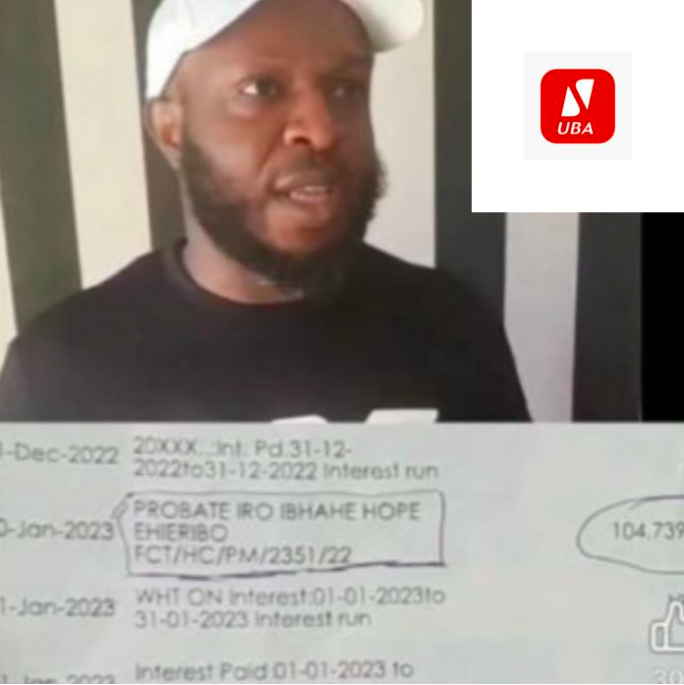
Ibhahe Hope Ehieribo’s statement of account


The allegation surfaced during a live video call with human rights advocate, Gwamnishu Harrison, who has pledged legal support to help the victim seek redress.

According to Ehieribo, the incident occurred in 2023 while he was still residing overseas. He explained that he had been saving consistently into his UBA account, making deposits multiple times each year.

However, upon his return to Nigeria, Ehieribo was stunned to learn from bank officials that his entire savings had been withdrawn. The funds, he was told, had been accessed by individuals who claimed he had passed away and was already buried.

The returnee recounted that when he visited the bank to demand clarification, police officers were already on standby, allegedly to arrest him for causing a disturbance.

He insisted that he merely raised his voice in shock and frustration after learning that his life savings had vanished.

Harrison has described the development as a clear violation of the customer’s rights and has vowed to take legal action against the financial institution.

Efforts by NATIONAL WAVES to get the bank side of the story yielded no fruits as at the time of filing this report, UBA had yet to issue an official response to the allegations.

However, Harrison later disclosed that the bank headquarters reached out to him and assured that it was on the issue.

“UBA headquarters have reached out. Let me sit and do a video update. UBA is utterly confused and shouting in dismay. The man’s wife resides abroad, and he does not have sisters. The beneficiaries of his over 100 million naira are Patience and Precious. My man does not know any of them.

“UBA bank reached out and they assured they are on his matter. It will interest you to know that before the money was awarded to unknown recipients, they obtained a Death certificate of a living being and went to probate at the high court to obtain a court order.

“Currently, the name the bank officials mentioned to us were the recipient, the victim, doesn’t know them. Please tag Central Bank of Nigeria and UBA Group.

“The bank will be held liable. They know what happened,” the activist claimed.

Watch video below

Facebook 0 Twitter 0 LinkedIn WhatsApp 0Shares

Business

UBA, GTCO Lose ₦2.13 billion To Fraudsters Despite Heavy Cybersecurity Investments

Published

on

UBA, GTCO Lose ₦2.13 billion To Fraudsters Despite Heavy Cybersecurity Investments—-Three of Nigeria’s largest financial institutions have reported combined fraud-related losses of approximately ₦2.13 billion in their latest audited financial statements, highlighting the growing threat of cybercrime and electronic banking fraud in the country’s financial sector.

The affected institutions include Access Holdings Plc, Guaranty Trust Holding Company Plc, and United Bank for Africa Plc.

According to details contained in the banks’ 2025 financial reports, fraud incidents linked to the three lenders totalled approximately ₦10.29 billion. However, through recoveries, transaction reversals, and security interventions, the banks were able to prevent or recover about ₦8.16 billion, leaving actual losses at approximately ₦2.13 billion.

Among the banks, Access Holdings recorded the highest direct loss to fraudsters, losing an estimated ₦1.24 billion within the financial year.

United Bank for Africa reported over 26,400 fraud-related incidents, with actual losses totalling approximately ₦621.57 million, while Guaranty Trust Holding Company recorded approximately ₦269.44 million in losses tied to fraudulent activities.

Industry analysts say the figures reflect the increasing sophistication of cybercriminals targeting Nigeria’s rapidly expanding digital banking ecosystem.

Most of the fraud cases were reportedly connected to electronic banking channels, including unauthorised transfers, mobile banking compromise, phishing schemes, identity theft, and other forms of digital payment fraud.

The development comes as Nigerian banks continue to accelerate the country’s transition toward a cashless economy through mobile banking platforms, internet banking services, agency banking networks, and digital payment systems.

Despite the losses, the financial institutions significantly increased investments in technology infrastructure and cybersecurity measures during the year under review.

Collectively, the banks reportedly spent over ₦280 billion on technology upgrades, fraud monitoring systems, customer authentication processes, and transaction security enhancements aimed at reducing cyber threats and protecting customer funds.

Meanwhile, the Central Bank of Nigeria has also intensified regulatory efforts to curb financial fraud across the banking industry.

The apex bank recently introduced stricter compliance measures requiring financial institutions to strengthen fraud detection systems, improve transaction monitoring, and respond more rapidly to suspicious activities and customer complaints.

Financial experts have warned that as digital banking adoption continues to rise across Nigeria, banks and customers alike must remain vigilant against increasingly advanced cybercrime tactics targeting the financial sector

Facebook 0 Twitter 0 LinkedIn WhatsApp 0Shares
Continue Reading

Breaking

BREAKING: Dangote Refinery Hikes Petrol And Diesel Prices Amid Economic Strain

Published

on

BREAKING: Dangote Refinery Hikes Petrol And Diesel Prices Amid Economic Strain—-Dangote Petroleum Refinery has revised its ex-depot prices, increasing the gantry price of Premium Motor Spirit (PMS), or petrol, to ₦1,175 per litre, while Automotive Gas Oil (AGO), commonly known as diesel, has been raised to ₦1,620 per litre.

The latest revision marks the fourth consecutive price review in less than two weeks amid global market volatility, according to a report by Petroleumprice.ng.

Quoting industry sources, the report noted that the new pricing template has been communicated to marketers, following earlier adjustments this month.

Under the revised structure, the ₦1,175 per litre petrol price reflects a significant jump from the previous ₦995 per litre, while diesel has surged sharply from its prior ₦1,430 per litre level, underlining the continued upward trend in domestic fuel pricing.

The development is likely to have a ripple effect across Nigeria’s downstream petroleum market, as depot operators and fuel marketers adjust supply costs in response to the revised prices announced by the country’s largest refining facility.

The refinery had yet to issue an official statement on the development as of the time of filing this report.

Oil prices soared 30 per cent today on fears about supplies from the Middle East, as the US-Israeli war against Iran continued into a second week with no sign of letting up.

Fears grew that the Middle East conflict could last for some time after US President Donald Trump said only the “unconditional surrender” of Iran would end the war.

He added at the weekend that the spike in prices was a “small price to pay” to eliminate Iran’s nuclear threat, reiterating the White House’s insistence that the rise is temporary.

Since the beginning of the war, WTI is up more than 75 per cent and Brent more than 60 per cent.

Attacks on oilfields were reported in southern Iraq and in the northern autonomous Kurdistan region, which forced a US-run oilfield to cease production, while the United Arab Emirates and Kuwait have started reducing output.

That came with maritime traffic in the Strait of Hormuz — through which a fifth of global crude and gas passes — halted since the war began on February 28.

Facebook 0 Twitter 0 LinkedIn WhatsApp 0Shares
Continue Reading

Trending

Facebook 0 Twitter 0 LinkedIn WhatsApp 0Shares